
The Annual Report of our Center for 2025 is available in Greek and in English
RCAAM presentation at the one-day workshop on February 19th 2024 at the central building of the Academy of Athens

Tuesday 13 October 2026, 12:00
WEBINAR
Michi Shinozaki
University of Tsukuba, Japan
Gravitational wave signal produced by the merger of two compact objects
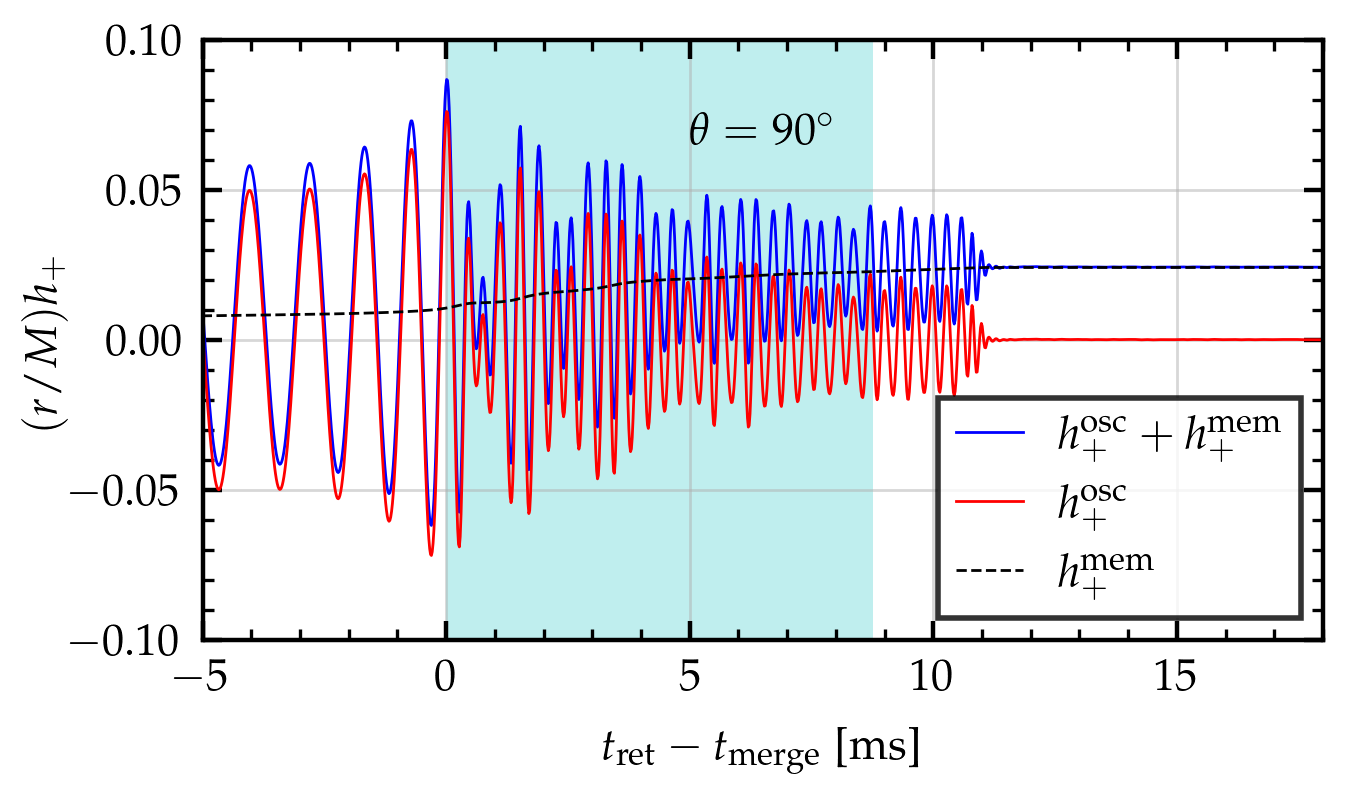
The h₊ strain polarization observed in the equatorial plane (θ = 90°), showing the oscillatory wave (red), the total displacement memory (black dashed), and the combined signal (blue) for a BNS simulation with total gravitational mass M = 2.70 M☉, mass ratio q = 1, ALF2 equation of state, and a pulsar-like magnetic field with |B|ₘₐₓ,ᵢₙₛ = 1.4 × 10¹⁶ G. The memory includes the gravitational, electromagnetic, and ejecta contributions, with the blue rectangle showing the time over which 90% of the postmerger memory is accumulated.
Abstract:
The gravitational wave signal produced by the merger of two compact objects includes both an oscillatory transient and a nonoscillatory part, the so-called memory effect. This produces a permanent displacement of test masses and has not yet been measured. We use general relativistic magneto- hydrodynamic simulations, including neutrinos, with several representative viable equations of state, to quantify—for the first time—the effects of the neutron star magnetic field, neutrino emission, and the ejected mass on the linear and nonlinear displacement memory in binary neutron star mergers. We find that the additional contributions due to the emission of electromagnetic radiation, neutrinos and baryonic ejecta can be ∼15% of the total memory for moderate magnetic fields and up to ∼50% for extreme magnetic fields. The memory is most affected by changes in the equation of state, the binary mass, and the magnetic field. In particular, for moderate premerger field strengths, the dominant impact of the electromagnetic field is the change in the gravitational wave luminosity, and the associated gravitational wave null memory, due to the unstable growth of the magnetic field and the resulting redistribution of angular momentum it induces in the remnant. While the direct electromagnetic contribution to the null memory is additive, the change in the gravitational wave null memory can—in some cases—result in the total memory being smaller than that from the corresponding nonmagnetized binary. Furthermore, in contrast to binary black hole mergers, the growth of the memory in binary neutron star mergers is extended due to the long emission timescale of electromagnetic fields, neutrinos, and ejecta. These results necessitate the consideration of the magnetic field, as well as the equation of state, for accurate parameter estimation in future analyses of gravitational wave memory data.
More information here
The Annual Report of our Center for 2025 is available in Greek and in English
RCAAM presentation at the one-day workshop on February 19th 2024 at the central building of the Academy of Athens